When a CVE Isn’t Your Vulnerability: Assessing CVEs in Medical Devices

What happens when a CVE (as in Common Vulnerabilities and Exposures) is identified in a third-party dependency used in your product, but the vulnerability isn’t actually yours?
That was the question behind my presentation, “When a CVE Isn’t Your Vulnerability,” which I was supposed to deliver at CySecMed Conference this year. Unfortunately, my car tyres had a critical weakness of their own – and unlike the CVEs I wanted to discuss, this one had a very real impact on my availability.
Jokes aside, CVEs can be misleading when taken at face value. A product name, a matching component, or a vulnerability description doesn’t automatically mean that your product is affected.
Understanding the context, verifying the actual exposure, and distinguishing between a theoretical match and a real vulnerability are essential parts of effective vulnerability management.
Let’s pretend our vulnerability scanner identifies a vulnerability in one of the used third-party dependencies with a CVSS score of 9.8.
Before discussing how to handle this finding, let’s briefly look at where it originates and how it is identified.
Software Composition Analysis (SCA) is a critical part of security risk management for medical devices. It helps identify the software components used in a product, including their dependencies and potential vulnerabilities. This information is typically documented in a Software Bill of Materials (SBOM), which provides an overview of the software components and their relationships.
SCA can be supported by various tools, some of which are introduced in the blog article on Software Composition Analysis.
A common misconception among medical device manufacturers is that the list of Software of Unknown Provenance (SOUP) required by IEC 62304 is equivalent to a Software Bill of Materials (SBOM).
This is not the case. While the SOUP list serves an important purpose in medical device software lifecycle management, SBOM provides a more comprehensive and structured inventory of software components and their dependencies.
The FDA refers to the National Telecommunications and Information Administration’s guidance (PDF) for the minimum contents of an SBOM. These include the following basic data fields:
Furthermore, an SBOM should be provided in both human-readable and machine-readable formats, such as SPDX, CycloneDX, or SWID, to support automated processing, vulnerability identification, and security analysis.
Identifying direct dependencies is usually straightforward.
The real challenge lies in identifying transitive dependencies: components that are not included directly in a product but are introduced indirectly through other software components on which the product depends. These dependencies can also contain vulnerabilities, making their identification essential for a meaningful security assessment.
In July 2026, CISA, together with other organizations, published a guidance outlining the minimum elements of a Software Bill of Materials (SBOM) (PDF). In addition to providing further information, such as the tools and tool versions used to generate an SBOM, the guidance addresses the question of how deeply dependency relationships should be analyzed.
The key message is that depth should not be the primary concern; coverage is what matters most. SBOM analysis should follow a risk-based approach and help software users and implementers quickly determine whether they are affected by a particular vulnerability.
Accordingly, the guidance emphasizes identifying all software components, including transitive dependencies. It also highlights the importance of explicitly documenting unknowns rather than creating a false impression of completeness or certainty.
The challenge with transitive dependencies is that Software Composition Analysis (SCA) tools can generate a large number of findings, including duplicates.
Consider a simple dependency chain: Library A depends on Library B, which in turn depends on Library C. All three libraries also depend on Library D. If Library D contains a vulnerability, the scanner may report the same vulnerability four times, once for each dependency path.
In addition, detected versions and package mappings are not always accurate. Consequently, a finding alone does not establish that a product is affected. The first step is to verify whether the vulnerable component and version are actually present. If they are, the next step is to determine whether the vulnerable code is reachable and whether the conditions required for exploitation can be met.

Verena Wieser, Medical device consultant
From vulnerability assessment and SCA/SBOM analysis to penetration and fuzz testing, Lorit supports manufacturers in addressing cybersecurity challenges throughout the product lifecycle.
Explore our Medical Device Cybersecurity services →
Learn moreLet’s consider a hypothetical medical device with embedded software and a Bluetooth interface. The device measures pressure, temperature, and water flow, transmitting only this non safety and data privacy critical data with timestamps to a companion app for documentation purposes. The app cannot modify the device’s configuration; the only information it sends to the device consists of embedded software updates.
An SCA tool identifies a vulnerability that could allow specially crafted Bluetooth messages to cause memory corruption or, under certain conditions, code execution.
The development team must now assess the actual product risk by answering several questions:
These questions cannot be answered by relying on the scanner output alone. The CVE assessment must be supported by technical evidence, such as dependency analysis, source code inspection, configuration details, or targeted testing.
One way to structure and communicate this assessment is through Vulnerability Exploitability eXchange (VEX). VEX is a machine-readable format for communicating the applicability and exploitability status of known vulnerabilities in a particular product. It helps manufacturers explain whether a product is affected by a reported vulnerability and why.
VEX defines several status categories, including Not Affected, Affected, Fixed, and Under Investigation. For example, a manufacturer may classify a product as Not Affected if the vulnerable code is not present, the affected functionality is not used, or the vulnerable code cannot be reached under the product’s actual configuration.
However, assigning a Not Affected status must never be a shortcut for dismissing a finding. Every such conclusion needs to be supported by documented technical evidence and a clear rationale.
The Exploit Prediction Scoring System (EPSS) estimates the probability that a vulnerability will be exploited in the wild within the next 30 days, helping teams prioritize their efforts. The CISA Known Exploited Vulnerabilities (KEV) Catalog, on the other hand, lists vulnerabilities known to have been exploited in real-world attacks.
Both provide valuable input for risk assessment, but neither determines whether a vulnerability affects a specific product. EPSS supports prioritization, while KEV provides evidence of known exploitation. Ultimately, product-specific technical analysis remains essential to determine applicability and actual risk.
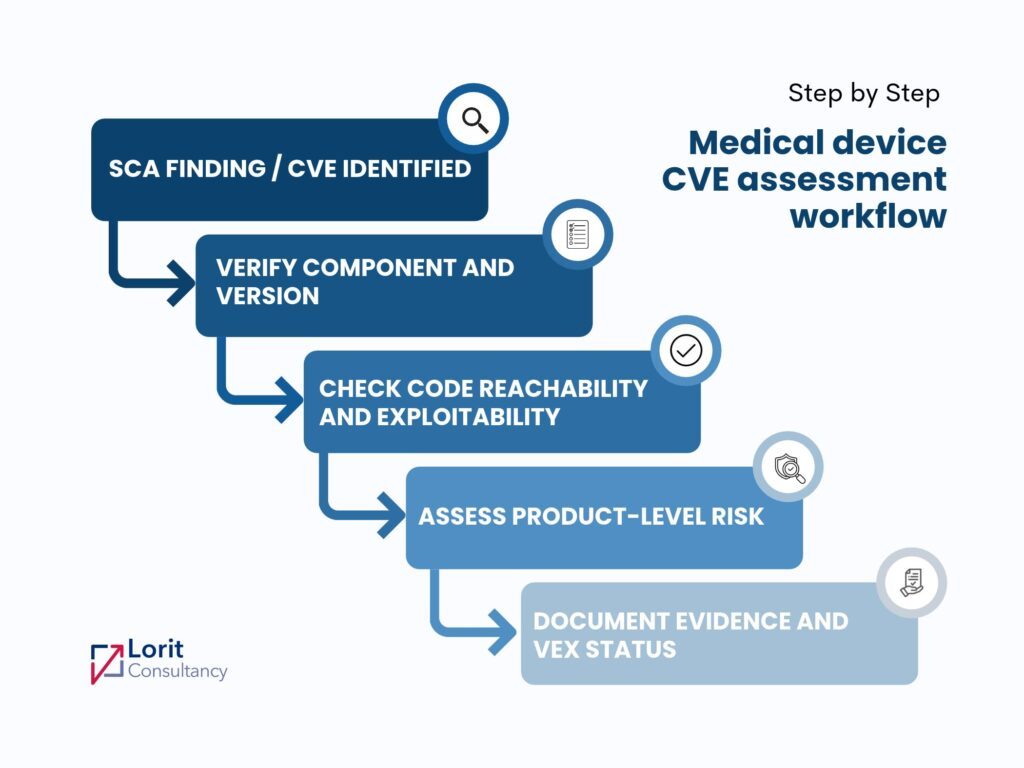
Depending on the nature of the finding and the architecture of the medical device, different verification activities can help establish whether the vulnerable code is present, reachable, and exploitable in the product context.
Typical activities include:
These activities provide different types of evidence and should be combined.
The choice of verification activities should be proportionate to the potential risk and the technical characteristics of the vulnerability. Not every finding requires every test method, but every conclusion – particularly a Not Affected status in VEX – must be justified by sufficient, traceable evidence.
Ultimately, the objective is not simply to reduce the number of findings in a vulnerability report. It is to distinguish genuine product risks or other risks such as privacy risks from irrelevant or non-exploitable findings – and to make that distinction transparent, reproducible, and defensible.
Finally, let’s return to our hypothetical medical device and look at another important aspect of the risk assessment: the system’s perspective.
Our software analysis indicates that the vulnerable code in the affected third-party dependency is never reached in the product’s actual configuration. This provides an important argument for concluding that the vulnerability does not affect the product. But we have another ace up our sleeve: the hardware itself.
Consider the device’s pressure regulator, waterflow regulator and heating element. All are designed with independent safety limits to prevent pressure, water flow or temperature from reaching damaging levels. Even if a software malfunction were to request an unsafe operating condition, these hardware safeguards would prevent the device from entering the corresponding hazardous state.
These mechanisms provide an additional layer of protection that complements our software-level analysis. Rather than relying exclusively on the assumption that the vulnerable code cannot be reached, we can also assess whether the device’s physical design limits the consequences of a potential software failure.
Of course, these safeguards must also be verified. Their independence from the potentially affected software, their operating limits, and their effectiveness under relevant fault conditions need to be supported by technical evidence.
This distinction is important: hardware safeguards do not automatically make a software vulnerability irrelevant. They can, however, provide additional evidence that the vulnerability cannot lead to a hazardous situation in the specific product context.
Assessing vulnerabilities in medical devices requires more than automated scanning. From SCA and SBOM analysis to vulnerability assessment and verification, manufacturers need a structured approach supported by technical evidence.
The key takeaway is that vulnerability assessment should consider the entire system – not just the software component flagged by the scanner. The combination of dependency analysis, verification activities, and independently effective hardware safeguards can provide a much stronger basis for a risk-based decision than the CVE finding alone.
No. A CVE identified in a third-party software component does not automatically mean that the medical device is affected. Manufacturers need to verify whether the vulnerable component and version are actually present, whether the affected code is reachable, and whether the conditions required for exploitation exist in the product’s actual configuration. The assessment should be supported by technical evidence.
Not necessarily. A high CVSS score indicates the severity of a reported vulnerability, but it does not establish whether a particular product is affected or whether the vulnerability can be exploited in its specific environment. Product-specific analysis is essential to determine actual exposure and risk. EPSS and the CISA Known Exploited Vulnerabilities (KEV) Catalog can provide additional information for prioritisation, but neither determines product applicability.
No. Although both provide information about software components, they serve different purposes. The SOUP list is part of medical device software lifecycle management, while an SBOM provides a more comprehensive and structured inventory of software components and their relationships, including dependencies. An SBOM therefore provides a broader basis for software composition analysis and vulnerability identification.
Vulnerability Exploitability eXchange (VEX) is a machine-readable format used to communicate whether a known vulnerability affects a specific product and why. It defines status categories such as Not Affected, Affected, Fixed and Under Investigation. VEX helps manufacturers communicate the results of their vulnerability assessments. A Not Affected status must always be supported by documented technical evidence and a clear rationale.
Depending on the vulnerability and product architecture, several verification activities can be used:
The selection of activities should be proportionate to the potential risk and technical characteristics of the vulnerability. Not every finding requires every test method, but conclusions should be supported by sufficient, traceable evidence.
By Verena Wieser, Medical Device Consultant
Address Austria:
Lorit Consultancy GmbH
Siezenheimer Straße 35
5020 Salzburg / Austria
Address UK:
Lorit Consultancy Ltd
1 Craigathie Road
Roslin Midlothian / Scotland EH25 9BG